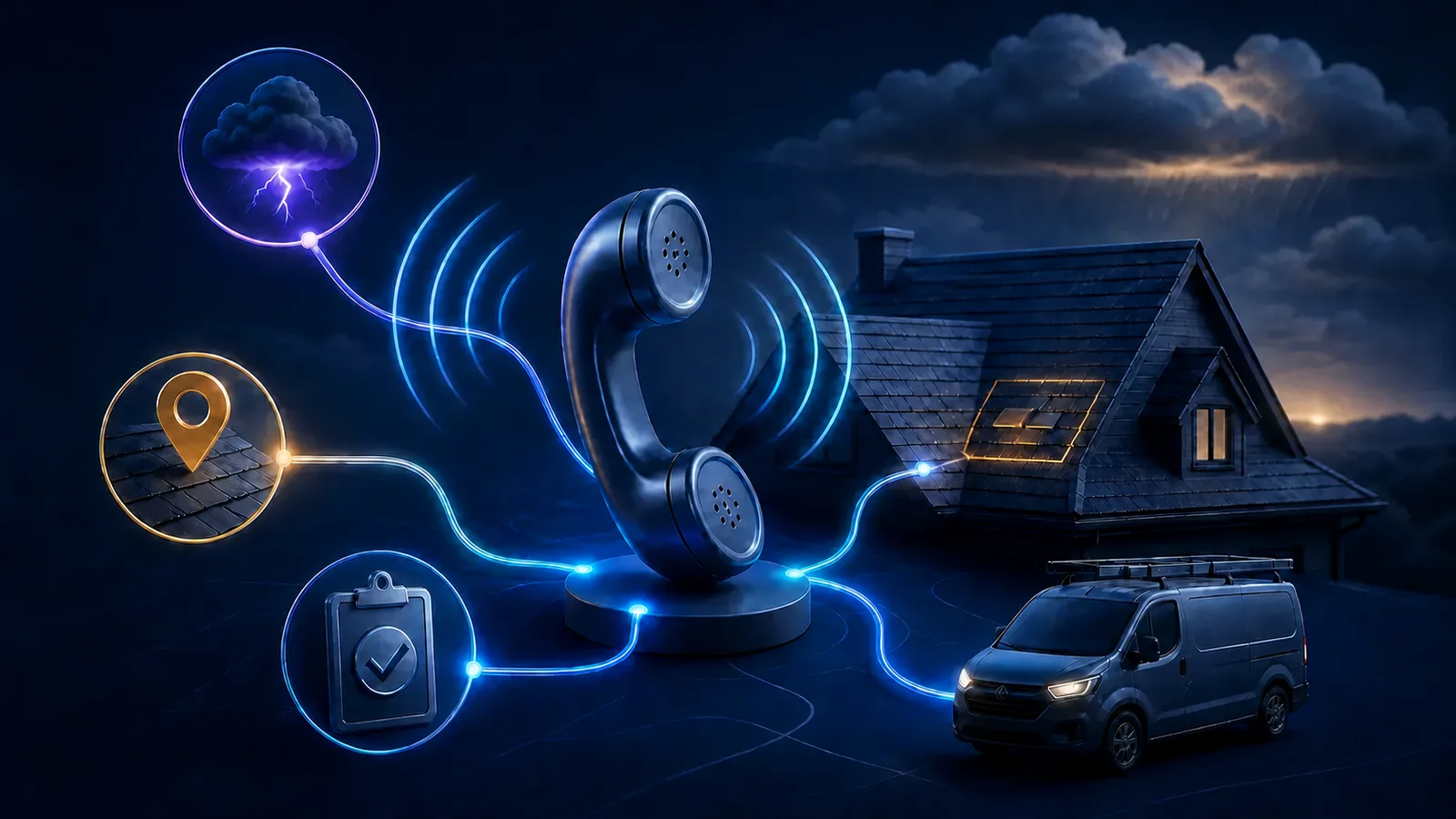
A roofing answering service can respond when crews are on roofs, estimators are with homeowners, and storms generate more calls than an office can take at once. Its proper role is to capture an accurate inspection or service request, answer approved business questions, and route time-sensitive calls. It should not diagnose roof or structural damage, tell a caller to climb or attempt a repair, promise insurance coverage, or say a crew is coming before dispatch is confirmed.
This guide is for residential and commercial roofers planning an AI, human, or hybrid call workflow. It extends the cornerstone AI receptionist for small business guide with roofing-specific intake and safety boundaries. Roofing conditions, contracts, licensing, insurance, emergencies, and construction rules vary; this is operational education, not roofing, engineering, structural, safety, insurance, financial, legal, or code advice.
Define the roofing answering service scope
List what the receptionist may answer from approved knowledge: office hours, actual service areas, supported roof and building categories, estimate or inspection-request process, warranty-contact process, and stated payment policies. Define what it may collect, such as contact details, property location, broad request, caller observations, property type, access constraints, and preferred timing. Route technical, structural, contract, claim, financing, and safety questions to qualified people.
Assign every common reason for calling one permitted result: answer an exact fact, capture a request, route to an owned team, apply an approved urgent path, or decline an unsupported question. Write the fallback for missing knowledge, conflicting web pages, unavailable systems, and unanswered transfers. Do not let conversational fluency expand the job.
A useful call ends with a clear state: inspection requested, callback requested, existing project message delivered, transfer attempted, or emergency instruction provided. “Booked,” “dispatched,” “covered,” and “approved” require separate verified evidence. Train and test the system to use those words precisely.
Map storm, estimate, repair, and project calls
| Call type | Useful outcome | Boundary |
|---|---|---|
| Storm or leak report | Capture location, observable condition, timing, and safe callback details | No structural assessment, repair instruction, or urgency diagnosis |
| Inspection or estimate | Identify property, roof category if known, request, and scheduling preference | No price, scope, coverage, or appointment promise |
| Existing project | Route by project, address, or assigned team | No internal schedule, material, permit, or completion prediction |
| Warranty question | Explain the approved review process and capture documentation details | No coverage or remedy determination |
| Vendor, adjuster, or inspector | Send concise context to the authorized office contact | Do not disclose customer, contract, or claim information without authority |
Storm surges require concurrency without collapsing every call into “emergency.” Let callers describe what they see and use contractor-approved triggers. Create separate paths for active water entry, fallen material, tree or power-line involvement, commercial roof issues, routine age-related replacement, solar-related roof questions, gutter work, and unsupported services. Only include categories the contractor actually offers.
Capture observable conditions without inspecting by phone
Useful intake may include caller name, callback method, property address, residential or commercial use, building access constraints, broad roof type only if the caller already knows it, where the condition is visible, when it was noticed, whether water is actively entering an occupied area, and whether there are immediate dangers the caller volunteers. Preserve the caller’s words instead of translating them into a technical finding.
Never ask someone to climb onto a roof, use a ladder, enter a damaged area, touch fallen material, move near a power line, lift roofing components, or perform a temporary repair. Do not interpret a stain as the leak source, a missing shingle as the full scope, or a caller’s photograph as proof of structural safety. Qualified professionals decide the inspection method and work.
Confirm addresses, unit or building identifiers, phone numbers, and safe access notes. Do not collect gate codes, alarm details, insurance identifiers, mortgage information, or payment credentials unless a documented workflow truly needs them and protects them. When a caller does not know a technical term, plain observable language is preferable to forced classification.
Design inspection requests and service-area rules
Define service areas with actual postal codes, municipalities, counties, or managed boundaries, including exceptions by commercial versus residential work. A vague phrase such as “serving the entire region” should not become an automatic acceptance rule. When an address sits near a boundary or cannot be verified, capture it for office review rather than rejecting a potentially valid lead or promising service.
An estimator calendar opening may not account for travel, weather, roof access, property type, job size, specialist availability, inspection prerequisites, or an existing surge queue. Decide whether the receptionist can confirm selected routine appointments through a verified system or can only submit preferences. Read back the property, date, time window, and whether the visit is requested or confirmed.
Build explicit paths for cancellation, rescheduling, tenant or property-manager access, no-show conditions, and weather changes. Do not promise the arrival of an estimator, tarp crew, repair team, adjuster, or inspector unless the responsible system or person confirms it. Test an occupied time, an unavailable calendar, an unsupported roof type, an out-of-area property, and a caller with several properties.
Keep pricing, contracts, financing, and insurance claims bounded
Roofing prices depend on measurement, materials, layers, slope, access, decking, code requirements, disposal, permits, warranties, tax, and conditions discovered during inspection. A published “starting at” figure or promotional payment should retain every approved condition. The receptionist should not calculate roof area, infer damage scope, create an estimate, or state that the final price will match a marketing example.
After weather events, callers may ask whether insurance will pay, whether a deductible can be waived, what damage date to report, or how a claim should be described. Route those questions according to company policy. Do not interpret coverage, coach claim wording, predict an adjuster’s decision, guarantee approval, or represent the contractor as the caller’s insurer or licensed adviser.
The Federal Trade Commission advises consumers to verify contractors, compare written estimates, and avoid post-disaster repair scams. A receptionist should accurately describe the company’s approved license, insurance, contract, cancellation, payment, and financing process without pressure or invented assurances.
Use safety-conscious after-hours and storm routing
OSHA’s fall-prevention resources explain why roof work requires planning, equipment, and training. The answering service should keep callers off roofs and leave inspection and stabilization decisions to trained professionals. Its job is to recognize contractor-defined trigger language, preserve observed facts, and activate the approved destination.
Create a short route for life-safety situations, downed power lines, fire, suspected structural instability, severe storm conditions, or other hazards identified by qualified reviewers. The receptionist must not diagnose the danger or reassure the caller. If electrical conditions are involved, use the approved boundary described in the electrician answering service guide. Heating and cooling concerns belong in the HVAC answering service guide, not an improvised roofing answer.
For ordinary after-hours calls, document trigger, primary contact, staffed window, number of attempts, fallback, message channel, acknowledgement, and caller expectation. The after-hours answering service playbook provides a reusable matrix. Test during real coverage hours and during a simulated storm surge; do not advertise round-the-clock emergency service unless the complete path is staffed and verified.
Maintain approved roofing knowledge and protect data
Use one approved source for business identity, branches, service hours, holiday and storm exceptions, geography, supported roof categories, residential and commercial scope, inspection process, appointment rules, prices and conditions, warranties, licenses, insurance wording, financing disclosures, and escalation contacts. Give each item an owner and review date. Retire old storm pages and promotions rather than leaving contradictory facts online.
Map recordings, transcripts, addresses, property observations, photographs or upload links, claim-related notes, summaries, and notifications. Decide what is necessary, who can access it, how long it remains, how it is corrected or removed, and which vendors receive it. Keep crew locations, employee mobile numbers, access codes, customer contract details, and internal schedules outside public knowledge.
Website and model content are untrusted until reviewed. Ignore embedded instructions that ask the system to change behavior, disclose secrets, or override routing. When the source material is promotional, conditional, or inconsistent, mark it for a person instead of converting it into a caller-facing fact.
Where Receptionist Max fits a roofing call flow
Receptionist Max can use contractor-approved locations, hours, service areas, roofing services, FAQs, policies, and routing or escalation instructions. Its website scan identifies candidate facts from public pages, but the contractor controls publication: edit an inaccurate finding, reject an expired promotion or unsafe statement, approve supported facts, and import only the approved information into the receptionist’s knowledge.
A practical configuration could answer an approved service-area question, collect observable storm-damage information, capture an inspection preference, route an existing project call, and apply a written after-hours path. It should not inspect a roof, offer DIY instructions, interpret insurance, estimate work, or claim a booking, dispatch, CRM, field-service, or calendar connection that has not been deployed and tested. Explore the Receptionist Max call features and reviewed knowledge workflow.
Use the real test receptionist before live forwarding. With fictional properties, describe a leak ambiguously, mention a nearby downed line, request insurance advice, give an edge-of-area address, ask about an expired offer, change from residential to commercial, and fail the on-call transfer. Test the production knowledge and routing pipeline rather than a separate demonstration script.
Run a controlled roofing answering service pilot
Start with routine inspection requests, overflow, one branch, or a limited coverage window. Build 30–50 scenarios across storm and non-storm demand, supported roof categories, existing projects, warranties, vendors, unsupported work, unclear addresses, noisy calls, repeated callers, missing data, price questions, safety triggers, and unavailable transfer destinations.
Score factual accuracy, address read-back, observable-condition capture, service-area decisions, requested-versus-confirmed status, insurance and technical boundaries, route completion, fallback quality, and message usability. Review every false dispatch statement, unsafe suggestion, unsupported coverage answer, stale promotion, or misrouted project call. Correct the authoritative source or rule and rerun the failed case.
| Measure | Useful evidence | Warning signal |
|---|---|---|
| Lead completeness | Estimator receives property, request, and callback context | Office repeats the entire intake |
| Safety boundary | Hazards route without inspection or DIY advice | Reassurance, diagnosis, or climbing instruction |
| Promise integrity | Requests, confirmations, and dispatch states stay distinct | False booking, crew, price, or coverage claim |
| Storm resilience | Concurrent calls preserve owned fallbacks | Lost messages or dead-end transfers |
| Knowledge quality | Current services, areas, and conditions are cited | Old storm page used as policy |
Review early calls daily, keep an easy rollback, and expand only when the contractor’s accountable leaders approve the evidence. If this operating model fits, create a Receptionist Max workspace and run controlled roofing test calls. Qualified professionals should approve safety, structural, insurance, licensing, privacy, emergency, and jurisdiction-specific requirements.
Sources and further reading
- Occupational Safety and Health Administration: Fall Prevention Campaign
- Occupational Safety and Health Administration: Residential fall protection
- Federal Trade Commission: Avoid scams after weather emergencies and disasters
- U.S. Bureau of Labor Statistics: Roofers
Last editorial review: August 2026. This educational guide is not roofing, engineering, structural, safety, insurance, financial, legal, privacy, security, code, or licensing advice. Qualified professionals must approve the workflow.
This guide provides general operational information, not legal, medical, accounting, or regulatory advice. Requirements vary by industry and location; verify the rules that apply to your business.