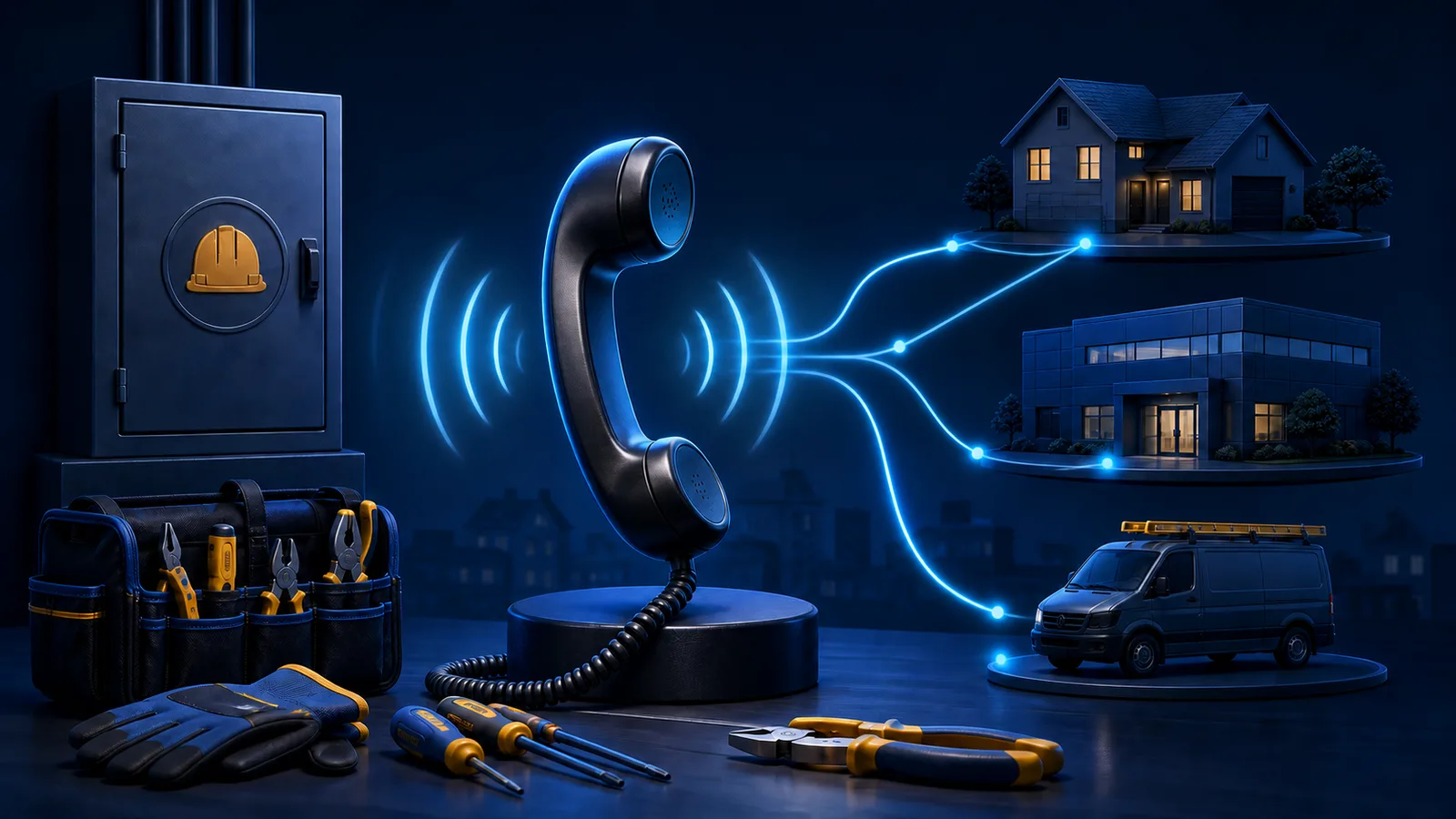
An electrician answering service can capture new work while electricians are driving, using tools, working at height, or concentrating near electrical equipment. It can answer approved business questions and send each caller to a clear next step. It must not diagnose an electrical condition, coach a caller through hazardous work, or promise that a technician has been dispatched when no authorized person or system has confirmed it.
This guide is for residential, commercial, and specialty electrical contractors building an accurate phone workflow. It complements the cornerstone AI receptionist for small business guide. Electrical hazards, codes, licensing, emergency procedures, and service practices vary, so qualified professionals must approve the actual rules. This is operational education, not electrical, emergency, workplace-safety, legal, insurance, or code advice.
Define what the electrician answering service may do
Start with a permission map. The receptionist may repeat current hours, service areas, supported job categories, appointment-request methods, and published administrative policies. It may collect observable facts in the caller’s words and request a visit. It may route a safety-sensitive description through a contractor-approved path. It should never troubleshoot equipment, identify a cause, tell someone to open or touch a panel, recommend a reset or repair, interpret code, or determine that a condition is safe.
Assign every frequent call one outcome: answer an approved fact, capture a request, route to a staffed destination, apply an approved urgent path, or decline an unsupported question. Document what the receptionist says when knowledge is missing, a transfer fails, or the caller demands advice. A short acknowledgement plus a safe next step is better than a confident technical guess.
Map electrical calls to owned outcomes
| Caller need | Useful receptionist outcome | Boundary |
|---|---|---|
| Routine installation | Capture property, service category, timing, and callback details | No scope, permit, compatibility, or price promise |
| Loss of power | Preserve observed facts and use the approved safety-sensitive route | No cause, hazard, utility, or restoration-time judgment |
| Burning smell, heat, sparks, or smoke | Keep intake short and apply the contractor-approved emergency path | No troubleshooting or reassurance |
| Existing appointment | Verify the minimum identifiers and route or capture the change | Do not expose schedules or confirm a change without authorization |
| Project, invoice, or inspection | Send context to the assigned office or project contact | No contract, payment, code, or inspection interpretation |
Build separate rules for residential service, commercial service, construction projects, generators, solar or storage work, low-voltage work, EV charging, and any other category actually offered. Do not let generic website language expand the contractor’s licensed scope, geography, equipment support, or after-hours coverage.
Link the route to an owner. A label such as “urgent” has little value unless a monitored destination knows what to do with it. Record primary and fallback contacts, staffed windows, transfer attempts, acknowledgement expectations, and the exact caller-facing wording when nobody is available.
Capture observable facts without troubleshooting
Ask callers to describe what they observe, not what they think caused it. Useful fields may include property address, residential or commercial setting, broad service requested, affected area, when the issue was first noticed, whether there is visible smoke or fire, whether anyone is in immediate danger, access notes, customer status, and reliable callback details. The contractor—not the model—decides which questions are permitted for each route.
Do not ask the caller to approach equipment for a better description, check wiring, remove a cover, touch a surface, operate a switch, test a breaker, or perform any other action. Do not transform “the lights flicker” into a diagnosis or label “one outlet stopped working” as routine. Preserve the caller’s own words in the summary and activate only the explicit trigger rules approved by the business.
Confirm addresses digit by digit where needed, including unit numbers, gate instructions that are appropriate to share, and service-area boundaries. Read back names and callback numbers. If the address cannot be verified, flag it rather than selecting a similar result. Minimize collection of tenant, payment, alarm, access, or other sensitive information that is not required for the next step.
Design scheduling and dispatch language that stays accurate
An open time on a calendar may not represent an eligible electrician, vehicle, material, travel window, permit dependency, safety condition, or job duration. Define which routine appointment types can be confirmed through a verified workflow and which are requests for office review. Use “requested” until the system of record or authorized dispatcher returns a confirmation.
For each supported service type, document geography, normal duration, eligible team, lead time, arrival-window wording, site requirements, estimate process, cancellation policy, and fallback when no slot fits. Do not quote an arrival time, service fee, total price, permit outcome, rebate, warranty coverage, or restoration time unless the exact approved source supports that statement for the caller’s situation.
“Message sent,” “transfer attempted,” “appointment requested,” “appointment confirmed,” and “technician dispatched” are different states. Make the call flow use the correct one. Test double booking, an unavailable calendar, a caller outside the service area, a job category the contractor does not offer, an occupied slot, and an on-call technician who does not answer.
Keep safety-sensitive calls short and professionally governed
OSHA explains that electricity can expose workers to shock, electrocution, fires, and explosions. Its guidance is written for workplace safety and qualified work practices; it is not a script for a receptionist to diagnose a customer’s building. Use it to understand why the phone system needs conservative boundaries, not to generate do-it-yourself instructions.
The contractor should have qualified professionals approve exact routes for smoke or fire, sparking, heat, burning odors, downed lines, electric shock, flooding near electrical equipment, damaged service equipment, total outages, medical-equipment concerns, and other descriptions relevant to its work. The receptionist should identify explicit trigger language, stop routine intake, deliver the approved instruction, and connect to the designated emergency, utility, or on-call path. It must not decide that a situation is harmless.
Test euphemisms and indirect language: “the wall feels strange,” “something popped,” “the box is buzzing,” or “we smelled something earlier.” Test background noise, children calling, a disconnected transfer, and a caller who refuses the offered route. Keep life-safety wording short, reviewed, and jurisdiction-appropriate.
Build after-hours escalation with a real fallback
Decide what the business truly supports outside office hours. Some contractors offer a staffed emergency service in defined areas; others accept messages for the next business day. Publish only the deployed coverage. Do not let the words “emergency electrician” on an old marketing page become a promise that someone is always available.
For every after-hours category, specify trigger, destination, coverage window, attempts, fallback destination, message channel, acknowledgement, and what the caller hears. The after-hours answering service playbook provides a reusable matrix. Verify each destination during the actual handoff window; a transfer number that works at noon may be unattended at midnight.
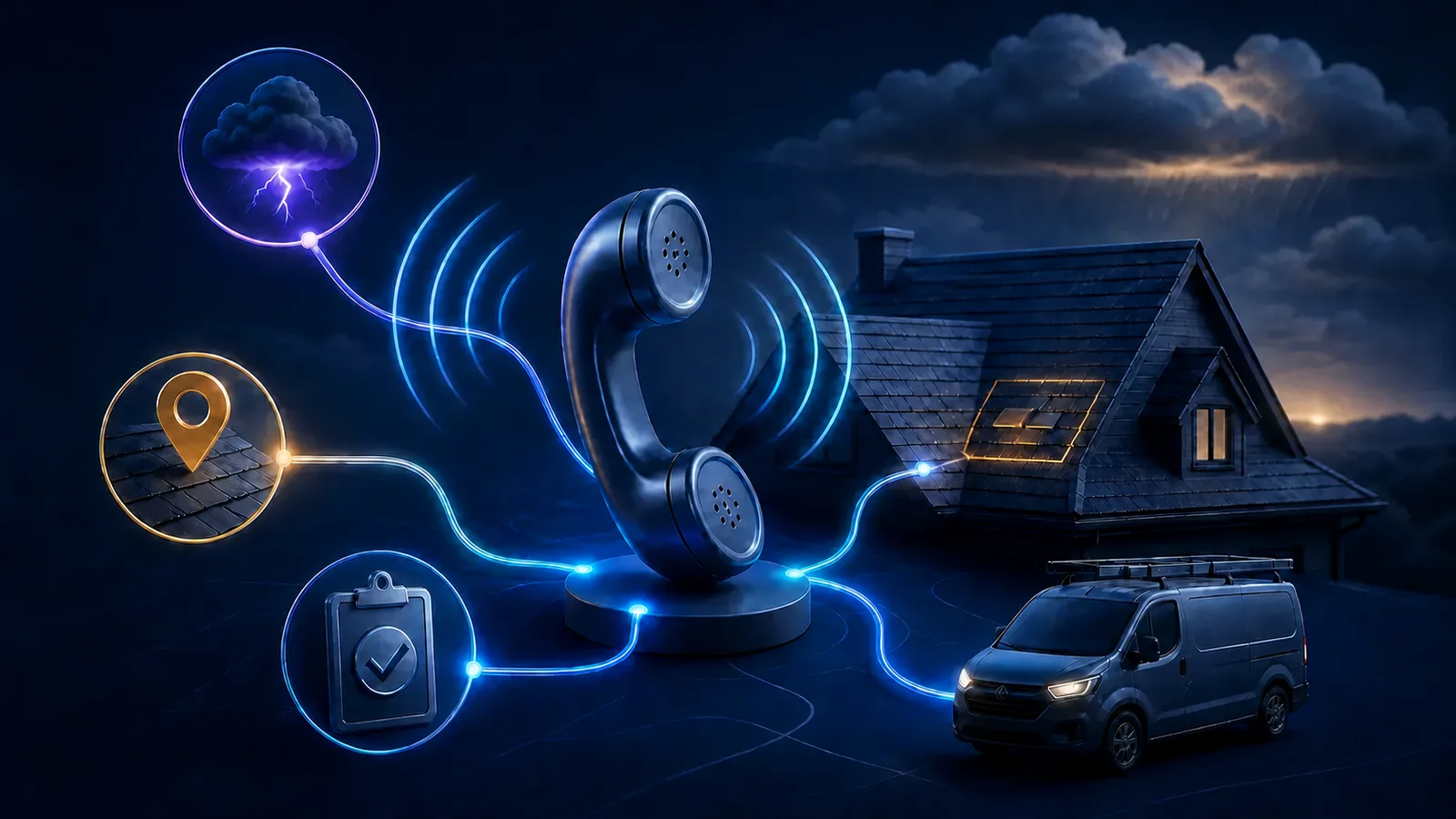
Related trades also need boundaries. The HVAC answering service guide covers heating and cooling call flows, while the roofing answering service guide addresses storm and roof-damage inquiries. Cross-route only when the businesses and recipients have explicitly approved it. Never imply that another trade is responding merely because its number appears in a directory.
Control electrical knowledge, pricing, and caller data
Maintain an approved source for company identity, office and service hours, geographic coverage, job categories, residential or commercial scope, license wording, estimate process, service fees, financing language, warranties, appointment rules, and escalation contacts. Give each entry an owner and review date. Separate factual service definitions from promotional phrases such as “same-day,” “24/7,” unconditional outcome promises, or “from” pricing.
Conditional prices require their conditions. A trip charge, diagnostic fee, advertised installation price, or financing offer may depend on location, equipment, access, electrical capacity, permits, tax, materials, credit approval, or inspection. The receptionist should state only the approved scope and route the rest. It should not calculate a quote or infer compatibility from a caller’s description.
Map recordings, transcripts, addresses, access notes, project details, and notifications. Limit collection, access, retention, and vendor permissions. Do not expose employee mobile numbers, crew locations, client access codes, internal schedules, or security details. Review multilingual safety language with qualified speakers so the outcome and handoff remain equivalent, not merely the greeting.
Where Receptionist Max fits an electrical contractor call flow
Receptionist Max can be configured with contractor-approved profile details, hours, service areas, electrical services, FAQs, policies, and routing or escalation instructions. Its website scan proposes information from the public site but does not silently publish it. The customer can edit a candidate, reject outdated or unsafe content, approve supported information, and import only approved findings into receptionist knowledge.
A practical configuration could answer an approved service-area question, capture a routine installation request, distinguish an appointment request from a confirmation, and apply a professionally written safety-sensitive route. It should not diagnose a fault, tell a caller what to touch, calculate a price, promise a dispatch, or claim a scheduling, field-service, or utility integration that has not been verified. Explore the Receptionist Max call features and reviewed knowledge workflow.
Use the real test receptionist before live forwarding. With fictional callers and addresses, describe sparks indirectly, request troubleshooting, give a borderline service-area address, ask for an unsupported price, change the job type midway, and make the on-call destination fail. The test should run through the production knowledge and routing pipeline.
Run a controlled electrician answering service pilot
Begin with routine leads, overflow, or a limited coverage window and keep immediate human oversight. Build at least 30–50 calls across supported work types, existing customers, commercial and residential distinctions, safety-trigger phrases, scheduling conflicts, failed transfers, unclear addresses, unsupported services, callers seeking code advice, and multilingual or noisy interactions.
Score factual accuracy, observable-fact capture, address and number read-back, requested-versus-confirmed language, safety-boundary adherence, correct destination, fallback completion, and message usability. Review every instance of advice, reassurance, wrong service-area acceptance, false dispatch language, or lost escalation. Correct the source or rule and rerun the exact scenario before widening coverage.
| Measure | Useful evidence | Failure signal |
|---|---|---|
| Lead quality | Office can act without repeating routine intake | Missing address, job type, or callback |
| Safety boundary | Observed conditions route without troubleshooting | Advice, diagnosis, or reassurance |
| Scheduling integrity | Requests and confirmations are labeled correctly | False booking or arrival promise |
| Escalation completion | Owned primary and fallback paths work | Dead end or unverified dispatch claim |
| Knowledge accuracy | Services, areas, and policies match approved sources | Promotional or stale content used as fact |
The OSHA electrical contractors resource reinforces that this is skilled, hazard-sensitive work. Keep the receptionist administrative and let qualified people control technical decisions. If that operating model fits, create a Receptionist Max workspace and run controlled electrical test calls. Obtain professional review for safety, emergency, licensing, code, privacy, and jurisdiction-specific requirements.
Sources and further reading
- Occupational Safety and Health Administration: Electrical contractors industry
- Occupational Safety and Health Administration: Electrical overview
- U.S. Bureau of Labor Statistics: Electricians
- Federal Trade Commission: Cybersecurity for small business
Last editorial review: August 2026. This educational guide is not electrical, emergency, workplace-safety, legal, insurance, privacy, security, code, or licensing advice. Qualified professionals must approve the workflow.
This guide provides general operational information, not legal, medical, accounting, or regulatory advice. Requirements vary by industry and location; verify the rules that apply to your business.