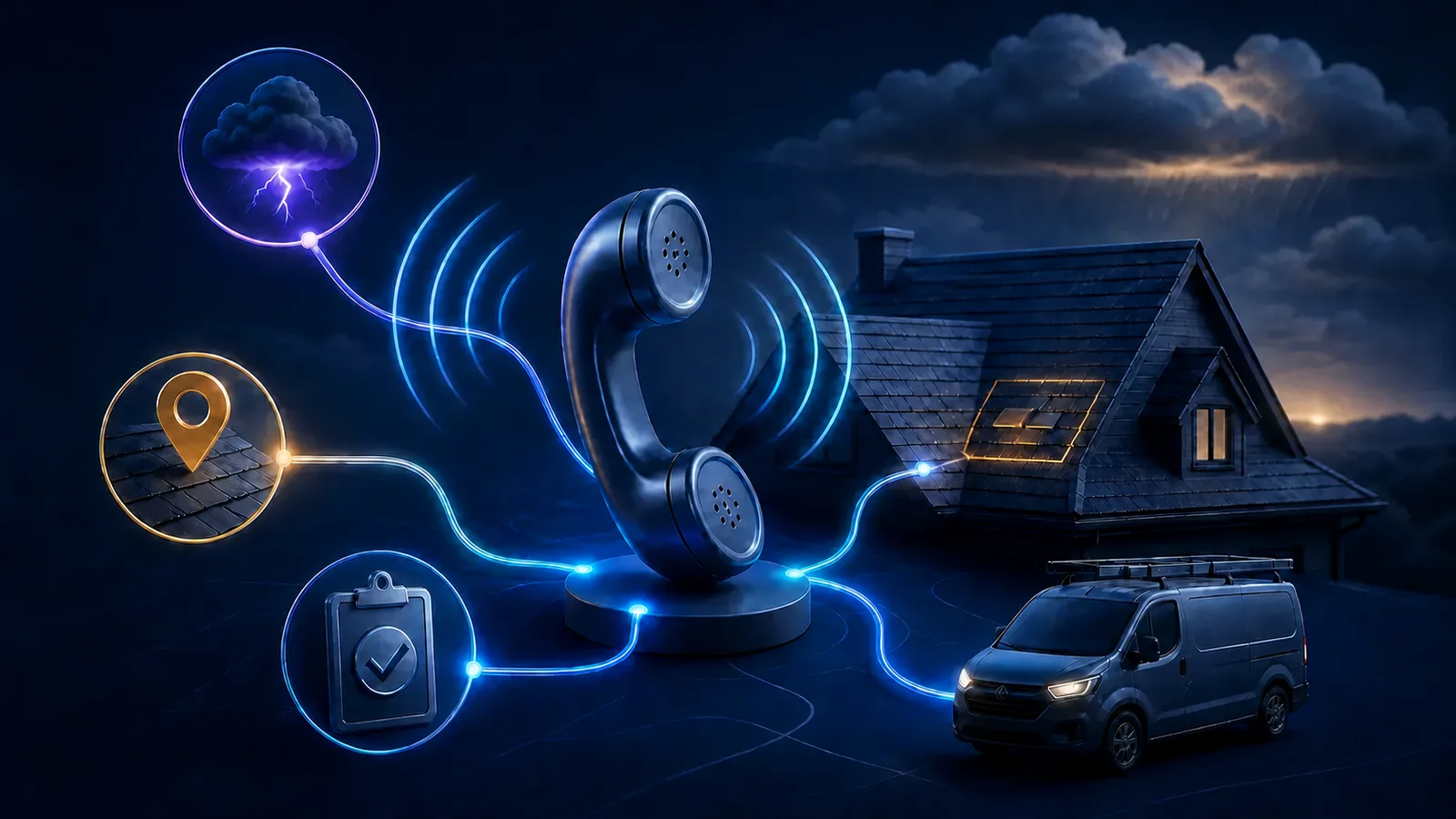
A pest control answering service can capture new requests while technicians are driving or working on properties and can absorb seasonal call spikes without sending every caller to voicemail. It can answer approved company facts, record what the caller observes, and request an inspection or service. It should not identify a pest from a phone description, recommend a pesticide or treatment, assess an exposure, diagnose structural damage, or guarantee that a service will eliminate a problem.
This guide is for residential and commercial pest-management businesses designing an AI, human, or hybrid call flow. It extends the cornerstone AI receptionist for small business guide. Pest identification, pesticide use, wildlife work, licensing, health questions, and emergency procedures require qualified professionals and jurisdiction-specific review. This is operational education, not pest-management, pesticide, medical, veterinary, structural, environmental, legal, or regulatory advice.
Define the pest control answering service scope
List the exact facts a receptionist may provide: current hours, supported service areas, residential or commercial scope, categories the company actually handles, inspection-request process, recurring-plan contact path, payment methods, and approved preparation or re-entry instructions tied to a specific confirmed service. It may capture a caller’s observations and desired timing. Identification, treatment selection, chemical guidance, exposure assessment, and guarantee decisions remain with licensed or otherwise qualified people.
Give each common call reason an authorized outcome: answer a current approved fact, capture an inspection request, route an existing account, apply a professionally written exposure or safety handoff, or decline an unsupported question. Document the fallback when the company does not handle the reported category, the service address cannot be verified, the schedule is unavailable, or a transfer fails.
Do not label every unpleasant sighting an emergency. Equally, do not reassure callers that a bite, sting, exposure, structural concern, food-service issue, or animal interaction can wait. The business should define objective trigger language and a destination; the receptionist applies that route without deciding the underlying risk.
Map new leads, recurring customers, and safety-sensitive calls
| Call type | Useful outcome | Boundary |
|---|---|---|
| New sighting or suspected activity | Capture property, visible location, caller words, and inspection preference | No species identification, severity rating, or treatment promise |
| Recurring-service customer | Verify approved identifiers and route service, billing, or follow-up request | No account disclosure or unauthorized policy exception |
| Termite or property-damage concern | Request inspection and preserve observations | No structural conclusion, repair scope, or guarantee |
| Pesticide exposure, bite, or sting | Use the company-approved professional or emergency resource path | No medical, veterinary, toxicology, or first-aid assessment |
| Commercial or regulated site | Route by account, site type, and authorized contact | No compliance, food-safety, documentation, or treatment representation |
Create distinct paths for homes, multifamily properties, restaurants, hospitality, healthcare, warehouses, schools, and other site types the company supports. Requirements differ, and a generic household script may be inappropriate for a regulated or occupied commercial location. Do not invent service for wildlife, protected species, fumigation, bed bugs, termites, mosquitoes, agricultural pests, or another specialty that the company has not approved.
Capture observable facts without identifying the pest
Useful intake may include caller name, callback method, service address, residential or commercial setting, whether the caller is a new or existing customer, where activity was observed, the caller’s own description, when it was noticed, whether people or animals may have contacted a product or creature, access constraints, and preferred timing. Qualified reviewers decide which fields are necessary for each path.
Ask “What did you observe?” rather than presenting a list that leads the caller toward a species. Images and descriptions may help a trained professional later, but the receptionist should not announce an identification or select treatment. Do not infer the size of an infestation, source of entry, structural condition, disease risk, product, dosage, treatment frequency, or whether occupants may remain in an area.
Read back addresses, apartment or suite numbers, phone numbers, and appointment preferences. If an insect, animal, product, or location term is unclear, preserve the words or spelling and flag uncertainty. Avoid collecting medical history, detailed health information, children’s information, pet records, payment credentials, or access codes unless an approved and protected workflow requires them.
Design inspection requests and service-area routing
Define service areas using maintained boundaries, including exceptions by service category. A company may cover general pest work in one geography but restrict termite, wildlife, mosquito, fumigation, or commercial work. When an address sits near a boundary, send it for review rather than making a confident acceptance or rejection from a marketing phrase.
A visible appointment slot may not account for technician license, route density, service category, site size, inspection duration, equipment, prior treatment, commercial requirements, or preparation. Decide which routine visits can be confirmed through a verified workflow and which remain requests. Read back the address, date, time or window, service category, and status.
Keep pricing, service assurances, and preparation instructions exact
Pricing can depend on the property, category, extent observed during inspection, treatment method, number of visits, monitoring, materials, access, geography, taxes, and plan terms. A public “starting at” price or free-inspection offer must retain every approved condition. The receptionist should not calculate a quote, promise a treatment plan, or state that a caller qualifies before the company’s process establishes it.
Service assurances and recurring plans have scope, exclusions, customer responsibilities, covered categories, response windows, and cancellation terms. Explain only the current approved wording. Route disputes, exceptions, refunds, re-service questions, and contract interpretations to authorized staff. Do not transform a “satisfaction” promise into an assurance of a particular biological or structural outcome.
Preparation, evacuation, ventilation, cleaning, pet, food, and re-entry instructions can depend on the actual product and treatment. Provide them only when tied to a confirmed service and an approved source from the qualified business. Do not synthesize generic instructions from the web or answer what is safe for a child, pregnant person, allergy, medical condition, pet, aquarium, garden, or food environment.
Route exposure, bite, sting, and immediate-danger concerns
The EPA advises consumers to evaluate professional qualifications and pesticide practices when choosing a pest control company. Use qualified staff to approve what the receptionist may say about company licensing, products, labels, and safety processes. The system itself should not interpret a label, select a pesticide, or determine exposure risk.
Build short, reviewed routes for possible pesticide exposure, bites or stings, breathing difficulty, loss of consciousness, fire, suspected gas, aggressive animals, and other scenarios relevant to the business. Poison Control’s immediate-assistance resource directs people with possible poison exposure to expert help and identifies conditions requiring emergency services. The company should approve the exact jurisdiction-appropriate wording; the receptionist should not conduct toxicology or medical intake.
If a concern involves a leak, moisture, or pipe condition, use the boundaries in the plumber answering service guide. If a caller reports roof or storm damage with animal or pest activity, the roofing answering service guide keeps structural and roof decisions with the appropriate trade. Cross-route only to verified, approved destinations.
Prepare for seasonal volume and after-hours demand
For each after-hours category, document trigger, destination, actual coverage hours, transfer attempts, fallback, message channel, acknowledgement, and caller wording. The after-hours answering service playbook provides a reusable matrix. Do not claim continuous emergency coverage simply because the answering technology can pick up a call.
Maintain approved knowledge and protect property data
Keep one approved source for locations, hours, seasonal exceptions, service areas, supported categories, inspection process, appointment rules, prices and conditions, plans, service assurances, preparation instructions, re-entry instructions, payment policies, licenses, and escalation contacts. Every item needs an accountable owner and review date. Retire expired seasonal offers and old product instructions.
Map recordings, transcripts, addresses, site descriptions, exposure mentions, account identifiers, summaries, images or upload links, and notifications. Define collection, access, retention, correction, and deletion. Protect commercial-site information, resident details, gate codes, alarm instructions, technician locations, employee mobile numbers, and internal product or route notes.
Where Receptionist Max fits a pest control call flow
Receptionist Max can use company-approved profile details, locations, hours, service areas, pest-management services, FAQs, policies, and routing or escalation rules. Its website scan gathers candidate information from public pages, but nothing has to be silently published. The customer can edit a conditional service or price, reject expired or unsafe content, approve supported facts, and import only approved findings into receptionist knowledge.
A practical configuration could answer an approved service-area question, capture a caller’s observable description, submit an inspection preference, recognize an existing account, and activate a professionally written exposure handoff. It should not identify a pest, choose a treatment, provide medical or pesticide advice, guarantee control, or claim a field-service, calendar, payment, or messaging integration that has not been deployed and tested. Explore the Receptionist Max call features and reviewed knowledge workflow.
Use the real test receptionist before live forwarding. With fictional properties and callers, describe an insect ambiguously, mention a child or pet, ask which chemical to use, request re-entry advice, give a boundary address, ask about an expired offer, switch from residential to restaurant service, and fail the exposure or after-hours route. Test the production knowledge and prompt pipeline.
Run a controlled pest control pilot
Start with routine inspection requests, overflow, one branch, or a limited coverage window. Build 30–50 scenarios across supported and unsupported categories, new and recurring customers, residential and commercial sites, service-area edges, price and guarantee questions, preparation requests, noisy calls, language changes, seasonal concurrency, possible exposure, unavailable schedules, and failed transfers.
Score caller and address accuracy, preservation of observable facts, absence of identification and treatment advice, service-area decisions, requested-versus-confirmed language, exposure-route completion, preparation accuracy, pricing boundaries, and message usability. Review every invented species, product suggestion, safety assurance, false booking, unsupported guarantee, or privacy failure. Correct the source or rule and rerun the scenario.
| Measure | Useful evidence | Failure signal |
|---|---|---|
| Lead quality | Team receives property, observations, and next-step context | Missing address or forced pest identification |
| Safety boundary | Exposure and health questions reach experts | Medical, veterinary, or pesticide advice |
| Promise integrity | Requests, bookings, prices, and service assurances stay precise | Unsupported treatment or outcome claim |
| Seasonal resilience | Concurrent calls retain complete owned routes | Lost leads or dead-end escalations |
| Knowledge accuracy | Current approved services and instructions are used | Expired offer or generic web advice |
The Bureau of Labor Statistics notes that pest control work involves training, licensing, and pesticide-safety responsibilities. Keep those professional decisions out of the receptionist. If this controlled model fits, create a Receptionist Max workspace and run pest control test calls. Qualified professionals should approve pesticide, exposure, health, wildlife, structural, licensing, privacy, and jurisdiction-specific requirements.
Sources and further reading
- U.S. Environmental Protection Agency: Choosing a pest control company
- U.S. Environmental Protection Agency: Tips for selecting a pest control service
- Poison Control: Get help for a poisoning
- U.S. Bureau of Labor Statistics: Pest control workers
Last editorial review: August 2026. This educational guide is not pest-management, pesticide, medical, veterinary, structural, environmental, legal, privacy, security, or regulatory advice. Qualified professionals must approve the workflow.
This guide provides general operational information, not legal, medical, accounting, or regulatory advice. Requirements vary by industry and location; verify the rules that apply to your business.